Analytically solvable model
Author: Pietro Bonfa’
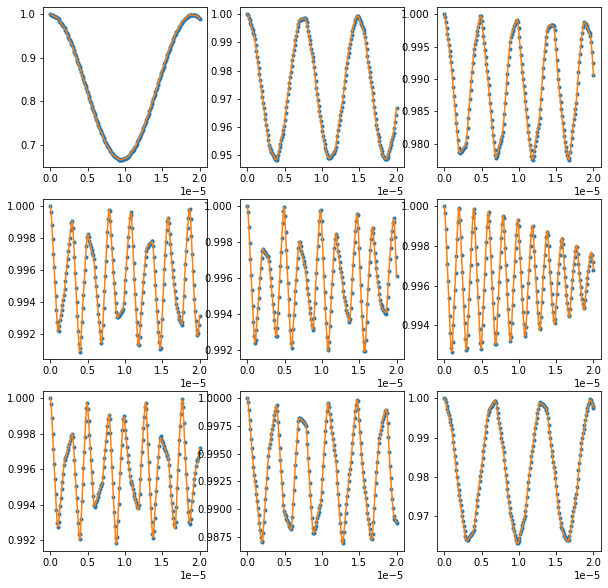
This example compares simulated and analytical results for a single mu-I interaction.
For the physical aspects, see A.Yaouanc and P. de Réotier, Muon Spin Rotation, Relaxation and Resonance, Oxford University Press, 2010, chapter 7, Fig. 7.1.
[1]:
try:
    from undi import MuonNuclearInteraction
except (ImportError, ModuleNotFoundError):
    import sys
    sys.path.append('../undi')
    from undi import MuonNuclearInteraction
import matplotlib.pyplot as plt
import numpy as np
from pprint import pprint
Define physical constants.
[2]:
angtom = 1.0e-10 # m, Angstrom.
elementary_charge = 1.6021766e-19 # Elementary charge, in Coulomb = Ampere*second.
epsilon0 = 8.8541878e-12 # Vacuum permittivity, in Ampere^2*kilogram^−1*meter^−3*second^4.
h = 6.6260693e-34 # J*s, Planck's constant.
hbar = h/(2*np.pi) # J*s, reduced Planck's constant.
mu0_over_4pi = 1e-7
Define the atomic positions for muon and Al nucleus.
[3]:
mu_pos = np.array([  0  ,   0.,   0.])
I_pos  = np.array([ 0. ,   0.,    1.0])

gamma_mu = 2 * np.pi * 135.55e6
# Taking Al values, any number would do herei,
gamma_I = 6.976e7
I = 5/2 # spin of Al
Quadrupole_moment_I = 0.1466e-28 # m^2, quadrupole moment of Al.

wd = 0.11e6 # s^-1
wd_to_d = np.cbrt((mu0_over_4pi) * gamma_mu * gamma_I * hbar / wd)
omega_E = 1.1e6 # s^-1
omega_E_to_Vzz = omega_E * hbar * 4 * I * (2*I -1) / (Quadrupole_moment_I * elementary_charge)

# scale distance to get the expected omega_d
I_pos *= wd_to_d
Define the atomic structure. Note that positions are rotated first and then transformed into Cartesian coordinates and SI units.
[4]:
def gen_radial_EFG(p_mu, p_N, Vzz):
    x=p_N-p_mu
    n = np.linalg.norm(x)
    x /= n; r = 1. # keeping formula below for clarity
    return Vzz * ( (3.*np.outer(x,x)-np.eye(3)*(r**2))/r**5 ) * 0.5
    # Final note, the last 0.5 is required since
    #  that the formula
    #     ( (3.*np.outer(x,x)-np.eye(3)*(r**2))/r**5 )
    #
    #  would give for p_mu=np.array([0,0,0.]) and p_N=np.array([0,0,1.])
    #
    #    array([[ 1., -0., -0.],
    #           [-0.,  1., -0.],
    #           [-0., -0., -2.]])
    #
    # thus the largest eigenvalue is 2 (absolute value is intended),
    # that multiplied by Vzz would give 2Vzz.


atoms = [
        {'Position': mu_pos,
         'Label': 'mu'
        },
        {'Position': I_pos,
        'Label': '27Al',
        'Spin' : I,
        #'OmegaQmu': 3*omega_E
        'EFGTensor': gen_radial_EFG(mu_pos, I_pos, omega_E_to_Vzz),
        'ElectricQuadrupoleMoment': Quadrupole_moment_I
        }
    ]

np.set_printoptions(precision=4)
pprint(atoms)
[{'Label': 'mu', 'Position': array([0., 0., 0.])},
 {'EFGTensor': array([[-9.8777e+20,  0.0000e+00,  0.0000e+00],
       [ 0.0000e+00, -9.8777e+20,  0.0000e+00],
       [ 0.0000e+00,  0.0000e+00,  1.9755e+21]]),
  'ElectricQuadrupoleMoment': 1.466e-29,
  'Label': '27Al',
  'Position': array([0.0000e+00, 0.0000e+00, 1.7859e-10]),
  'Spin': 2.5}]
Polarization function.
Compute the polarisation function for various longitudinal fields
[5]:
steps = 200
tlist = np.linspace(0, 20e-6, steps) # Time scale, in seconds.
Define the applied external magnetic fields, in Tesla.
[6]:
LongitudinalFields = np.array([0.0, 0.001, 0.00164, 0.003, 0.00329, 0.004, 0.005, 0.006, 0.007])

print("Computing signal for various longitudinal fields...", end='', flush=True)

signI_positive_EFG = np.zeros([len(LongitudinalFields), steps]) # Define the polarization signal with positive EFGs.

for i, B in enumerate(LongitudinalFields):

    # Align the external field along z i.e. parallel to the muon spin.
    B_pos = B*np.array([0.,0.,1.])

    NS = MuonNuclearInteraction(atoms, external_field=B_pos, log_level='warn')

    signI_positive_EFG[i] = NS.polarization(tlist)

    del NS

print('done!')
Computing signal for various longitudinal fields...
Warning, overriding quadrupole moment for 27Al
Warning, overriding quadrupole moment for 27Al
Warning, overriding quadrupole moment for 27Al
Warning, overriding quadrupole moment for 27Al
Warning, overriding quadrupole moment for 27Al
Warning, overriding quadrupole moment for 27Al
Warning, overriding quadrupole moment for 27Al
Warning, overriding quadrupole moment for 27Al
Warning, overriding quadrupole moment for 27Al
done!
The Hamiltonian describing I-mu interaction is
where
and
The solution is
But there is a mismatch of a factor 2 in \(\omega_d\). It appears to be required also to reproduce the plots in the book.
[7]:
MISTERIOUS_FACTOR_TWO = 2
rm = lambda wid, I, m: (wid/2.) * np.sqrt(I*(I+1) - m*(m-1))
sm = lambda we, wid, wi,wmu, m: (2*m-1)*(3*we+wid/2) - wi + wmu

def pz(t, I, wid, we, B=0):
    s = np.zeros_like(t)
    wi  = gamma_I * B
    wmu = gamma_mu * B
    for m in np.arange(-I,I+1,1):
        s2 = (sm(we, wid, wi, wmu, m))**2
        r2 = (rm(wid,I,m))**2
        s += (s2 + r2 * np.cos(np.sqrt(s2+r2)*t))/(s2+r2)
    s /= (2*I+1)
    return s

f, axes = plt.subplots(nrows=3,ncols=3,figsize=(10,10))
for i in range(3):
    for j in range(3):
        # Just an index to plot results in various panels
        l = i+j*3
        axes[j,i].plot(tlist, signI_positive_EFG[l],'.')
        axes[j,i].plot(tlist, pz(tlist,I,MISTERIOUS_FACTOR_TWO*wd,omega_E,B=LongitudinalFields[l]))